











Shopping Cart
There are no more items in your cart









Why the Specific Wavelength of Light Determines Everything
Not all light is created equal — and when it comes to therapeutic applications, the specific wavelength of light you use isn't just one of many factors to consider. It is the factor. The biological effects of light are exquisitely wavelength-dependent: photons at 660nm behave in fundamentally different ways inside biological tissue than photons at 850nm, and both are categorically different from photons at 530nm (green light) or 470nm (blue light). Understanding this wavelength specificity is the foundation of intelligent red light therapy use and the key to separating devices and protocols that work from those that merely look convincing.
The science behind this specificity is captured in the concept of the "optical window" — the range of wavelengths between approximately 600nm and 1000nm within which light can penetrate biological tissue most efficiently. Below 600nm, light is heavily absorbed by haemoglobin and other tissue pigments, limiting penetration depth. Above 1000nm, water absorption increases dramatically, turning light energy into heat rather than photochemical cellular signals. The 630–850nm range represents the therapeutic sweet spot — deep enough penetration to reach clinically relevant tissues, specific enough wavelength to trigger precise biological responses.
Red Light Wavelengths: 630nm and 660nm Explained
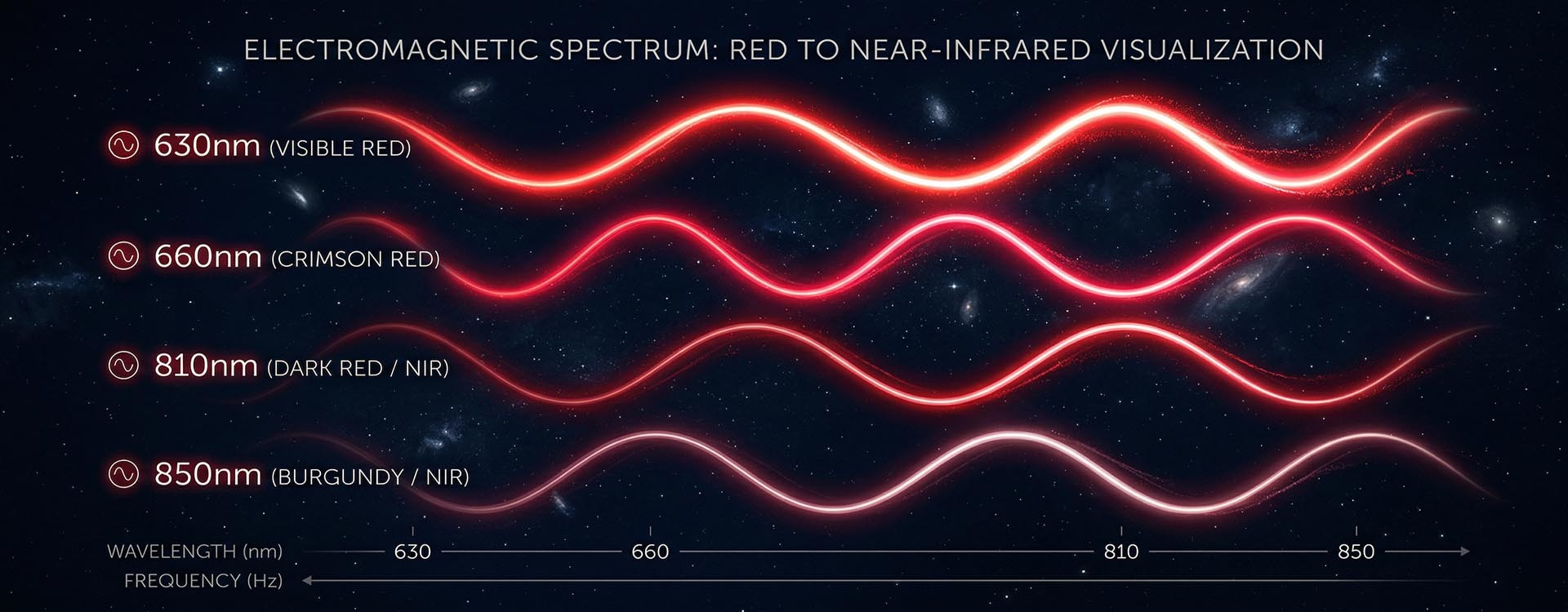
Within the red light portion of the therapeutic spectrum, two wavelengths dominate clinical and consumer applications: 630nm and 660nm. The 630nm wavelength sits at the visible boundary of red light and is absorbed with particular efficiency by chromophores in the skin's upper layers — making it especially effective for surface-level applications including acne treatment, surface wound healing, and skin pigmentation concerns. Its penetration depth is more limited than longer red wavelengths, typically reaching two to three millimetres into the skin.
The 660nm wavelength is the most widely studied and clinically applied red light frequency in photobiomodulation research. It is absorbed strongly by cytochrome c oxidase within the mitochondria of skin fibroblasts, keratinocytes, and other superficial tissue cells, making it the primary wavelength for collagen stimulation, anti-aging skin treatment, and wound healing acceleration. The irradiance requirements for 660nm are well-established through clinical research, making it the most evidence-backed wavelength for consumer skincare and surface tissue treatment. Most quality red light therapy devices targeted at skin benefits will feature 660nm as their primary or only red wavelength.
Near-Infrared Wavelengths: 810nm, 830nm, and 850nm
Moving beyond the visible spectrum into near-infrared territory opens up a new tier of therapeutic possibility — deeper tissue penetration and access to biological targets inaccessible to visible red light. The 850nm wavelength is the most commonly used NIR frequency in consumer devices, penetrating four to five centimetres into tissue to reach muscles, tendons, joints, peripheral nerves, and subcutaneous fat. Its biological effects include deep muscle recovery acceleration, joint inflammation reduction, neuropathic pain modulation, and lymphatic circulation support.
The 810nm wavelength has attracted particularly intense research interest due to its penetration characteristics in neural tissue. Studies have demonstrated that 810nm NIR light can penetrate the human skull and influence neuronal mitochondrial function — making it a subject of active investigation for conditions including traumatic brain injury, mild cognitive impairment, depression, and neurodegenerative diseases. The 830nm wavelength offers a therapeutic profile that bridges skin and deeper tissue applications, and is increasingly incorporated into multi-wavelength devices designed to address a broad range of biological targets simultaneously.
Multi-Wavelength Devices: The Case for Combining Frequencies
If individual wavelengths each target specific biological processes, the logical question is whether combining wavelengths delivers superior results. The evidence suggests it does. Research on photobiomodulation consistently demonstrates that the simultaneous or sequential application of complementary wavelengths produces synergistic effects — with each wavelength addressing different depth layers and cellular targets, and their combined effects producing more comprehensive biological responses than any single wavelength could achieve alone.
This is the rationale behind multi-wavelength flagship devices like the RedLightLux Ultimate, which combines five wavelengths (630nm, 660nm, 810nm, 830nm, and 850nm) in a single panel. The 630nm and 660nm red wavelengths address skin-level collagen stimulation, pigmentation, and wound healing, while the 810nm, 830nm, and 850nm NIR wavelengths simultaneously target deeper tissues — muscles, joints, nerves, and potentially even brain tissue. The result is a genuinely comprehensive therapeutic light environment that mirrors the full-spectrum solar light our bodies evolved alongside, rather than the narrow-band artificial light our modern environments provide.
Reading the Science: How to Evaluate Wavelength Research
As you explore the scientific literature on red light therapy and wavelengths, a few guiding principles will help you evaluate research quality. Look for studies that specify exact wavelengths used, irradiance levels, treatment distances, session durations, and frequency of treatment — the absence of any of these variables from a study's methodology should prompt caution about the generalisability of its findings. Be aware that the same wavelength can produce different outcomes depending on the irradiance delivered: both insufficient and excessive doses can produce sub-optimal results, a phenomenon known in photobiomodulation research as the "biphasic dose response."
The most credible sources in this field include peer-reviewed publications in journals such as Photomedicine and Laser Surgery, the Journal of Biophotonics, and Lasers in Medical Science, as well as systematic reviews and meta-analyses that aggregate findings across multiple individual studies. The field of photobiomodulation has matured considerably in the past decade: the evidence base is now substantial enough to support confident clinical application, and the ongoing research pipeline is rapidly expanding our understanding of the full therapeutic potential of the electromagnetic spectrum we've been swimming in since life began.