







Shopping Cart
There are no more items in your cart




Why Choosing the Right Device Matters More Than You Think
The red light therapy device market has grown at remarkable speed, and with that growth has come an equally remarkable volume of confusion. Walk into any online marketplace and you will find hundreds of devices claiming to deliver photobiomodulation benefits — ranging from €30 handheld gadgets to €2,000 professional panels. The quality variation is extreme, and the consequences of choosing poorly are significant: an underpowered or incorrectly specified device will not deliver the therapeutic benefits you're looking for, no matter how consistently you use it.
Understanding what separates an effective device from an ineffective one is not complicated — but it does require knowing which specifications actually matter. This guide cuts through the marketing noise to give you the technical knowledge you need to make a confident, informed purchasing decision.
The Non-Negotiable Specifications: Wavelength and Irradiance
Two specifications define whether a red light therapy device will actually work: wavelength and irradiance. Wavelength determines which biological targets the light can reach and stimulate. The therapeutically validated range for red light is 630–660nm — this is the range absorbed by skin-level chromophores, fibroblasts, and surface tissues. For deeper penetration into muscles, joints, and nerves, near-infrared wavelengths of 810–850nm are required. Devices that emit light outside these specific ranges — or that fail to specify their wavelengths precisely — should be treated with scepticism.
Irradiance, measured in milliwatts per square centimetre (mW/cm²), is the measure of how much therapeutic light energy actually reaches your tissue at the treatment distance. This is the most commonly misrepresented specification in the consumer device market. Many budget devices claim impressive LED counts or high wattage but deliver inadequate irradiance at treatment distance — often because their LEDs are low-quality, poorly arranged, or positioned behind diffusing covers that reduce effective output. Look for independently verified irradiance data measured at realistic treatment distances (typically 10–30cm), not raw panel power figures.
Panels vs. Masks vs. Wands: Matching the Device to Your Goals
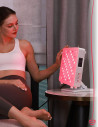
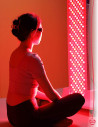
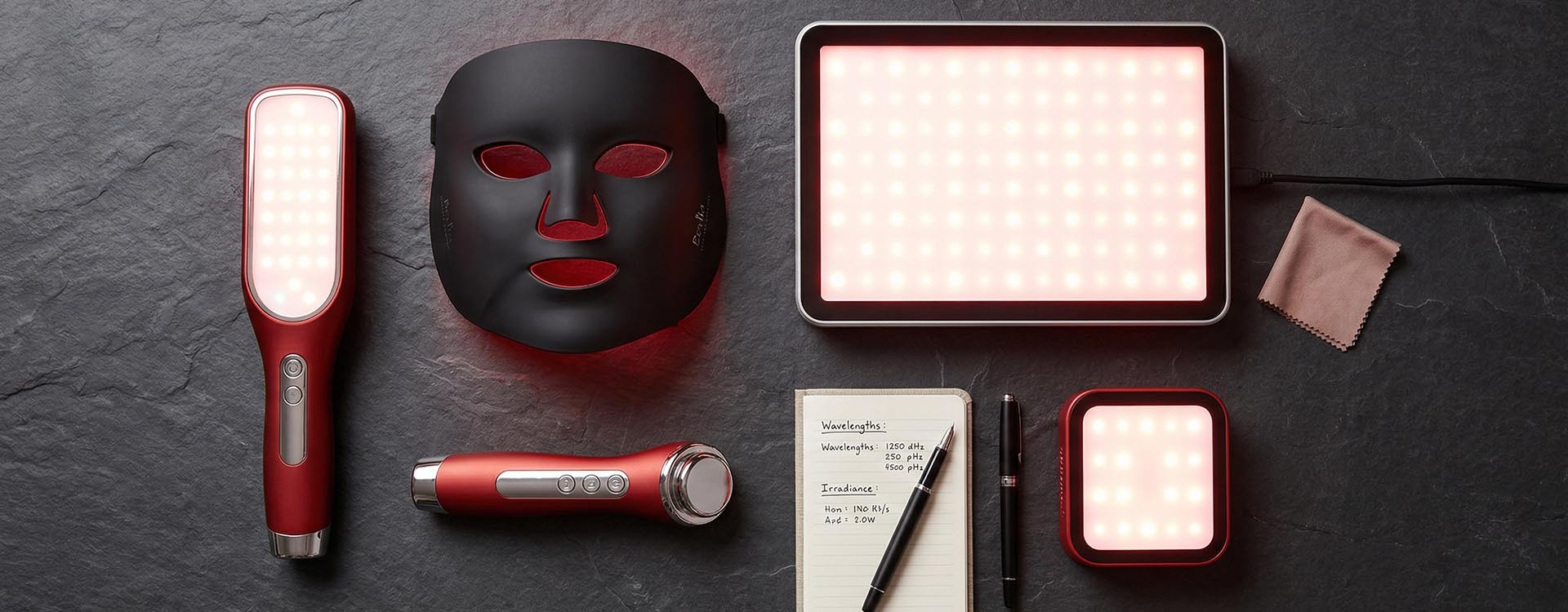
The format of your device should be determined primarily by the areas you intend to treat and the goals you're pursuing. Full-size panels (ranging from compact 30×20cm units to full-body 120×60cm panels) offer the highest irradiance and greatest coverage — ideal for users targeting large areas like the back, full-body recovery, or those seeking systemic benefits. They require dedicated space and a fixed position in your home, but deliver the most clinically relevant light doses.
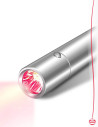
LED face masks are purpose-built for facial skincare applications: hands-free, precisely fitted to the contours of the face, and typically emitting the 630–660nm wavelengths most relevant for collagen stimulation and acne treatment. The trade-off is limited coverage area and generally lower irradiance than panel devices, making them best suited to skincare-focused users rather than those with pain or recovery goals. Handheld wands offer targeted, portable treatment — excellent for spot-treating specific pain areas, scalp stimulation for hair growth, or travel use. Their limitations are coverage area and the effort required to hold them in position during sessions.
EMF, Flicker, and the Safety Specifications That Matter
Beyond therapeutic performance, the safety profile of a red light therapy device is a legitimate consideration — particularly for daily users. Electromagnetic field (EMF) emissions are a concern for some users, especially given the proximity of devices to the body during sessions. Quality manufacturers publish independent EMF test results and design their devices to minimise field emissions; budget devices rarely offer this transparency. Look for devices explicitly marketed as low-EMF with supporting test documentation.
LED flicker is another often-overlooked safety factor. Many low-cost LED devices flicker at frequencies above the threshold of visual perception but within the range that can cause neurological strain, eye fatigue, and headaches with extended exposure. Flicker-free devices use quality LED drivers that maintain constant, stable light output. Certifications to look for include CE marking (for European market compliance), FDA clearance or registration (for devices sold in the US market), and RoHS compliance (confirming the absence of hazardous materials). Warranty terms are a useful proxy for manufacturer confidence: quality devices are typically backed by at least one year of comprehensive coverage.
Cheap vs. Premium: Is It Worth Spending More?
The honest answer is: it depends on what you need, but the performance gap between budget and quality devices is real and significant. A €30 device from an unknown brand will not deliver the irradiance levels required for meaningful photobiomodulation — the LEDs are typically low-power, the wavelengths often imprecise, and quality control absent. For occasional supplementary use, such a device may not cause harm — but it is unlikely to produce the results you're looking for.
Mid-range quality devices (typically €100–€400 for targeted panels and masks) from established brands with verified specifications represent the sweet spot for most consumer users: sufficient irradiance and wavelength accuracy to produce genuine therapeutic results, at a price point that represents good long-term value compared to ongoing clinical sessions. Premium devices (€500–€2,000+) are appropriate for users seeking full body coverage, maximum power output, multi-wavelength sophistication, or commercial/professional-grade durability. When evaluating any device, always ask: what is the independently verified irradiance at 10cm and 30cm? What exact wavelengths does it emit? And what does the warranty actually cover? These three questions will separate the effective from the ineffective more reliably than any marketing claim.