







Shopping Cart
There are no more items in your cart







Beyond the Visible: What Is Near-Infrared Light?
When most people think of light therapy, they picture the warm red glow of a panel. But some of the most powerful therapeutic work happens completely invisibly. Near-infrared (NIR) light — wavelengths typically between 800nm and 1000nm — sits just beyond the edge of human vision, yet its effects inside the body are profound and well-documented. Near-infrared therapy is a branch of photobiomodulation that has quietly become one of the most researched areas of non-invasive health technology.
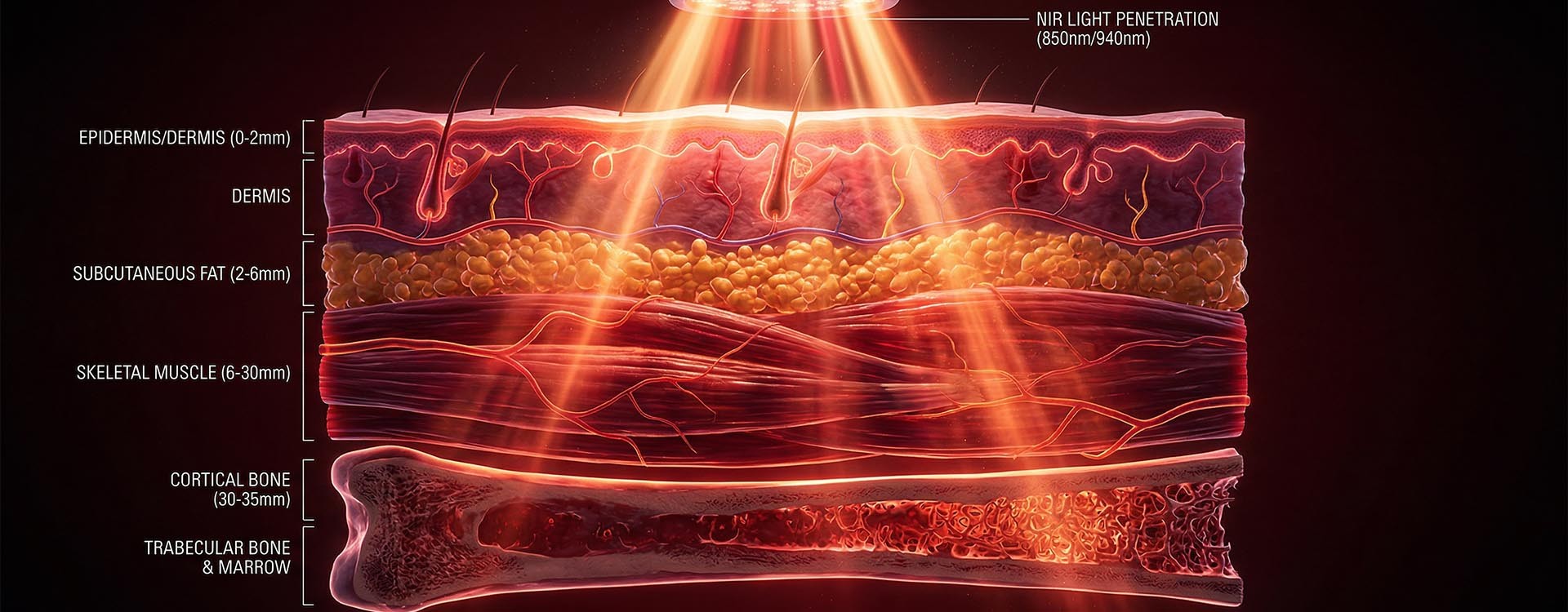
Unlike visible red light, which is primarily absorbed in the skin's surface layers, near-infrared light penetrates significantly deeper — reaching muscles, joints, connective tissue, and even bone. This depth of penetration is what makes NIR therapy uniquely suited for applications that go far beyond skincare, including pain management, neurological support, and deep tissue recovery.
How Near-Infrared Light Interacts with Your Biology
The biological mechanism of near-infrared therapy mirrors that of red light therapy, but with greater reach. NIR photons are absorbed by chromophores — light-sensitive molecules — within the mitochondria, most notably by cytochrome c oxidase. This absorption supercharges ATP production, the primary energy currency of cells, and triggers a cascade of healing processes: reduced inflammation, improved blood circulation through nitric oxide release, accelerated tissue repair, and modulation of reactive oxygen species (ROS).
What makes NIR particularly interesting is its ability to cross the blood-brain barrier in certain wavelengths (notably around 810nm), making it a subject of active research in neurodegenerative disease, traumatic brain injury, and cognitive performance. The body is far more transparent to NIR wavelengths than to visible light — a property that scientists and clinicians are only beginning to fully exploit.
The Wavelength Difference: 810nm, 830nm, and 850nm Explained
Not all near-infrared light is the same, and understanding wavelengths is key to getting the most from your therapy. The 850nm wavelength is the most commonly used in consumer NIR devices and offers excellent deep tissue penetration — ideal for muscle recovery, joint pain, and inflammation reduction. The 810nm wavelength has attracted significant research attention for its neurological applications, as it appears to be particularly well-absorbed by brain tissue. The 830nm wavelength, used in some advanced multi-wavelength devices, sits between these two and offers a balanced profile of skin and tissue benefits.
Devices like the RedLightLux Ultimate panel combine multiple wavelengths — including 630nm, 660nm, 810nm, 830nm, and 850nm — to deliver a comprehensive light diet that addresses both superficial and deep biological targets simultaneously. This multi-wavelength approach is increasingly supported by research suggesting that different tissues respond optimally to different parts of the light spectrum.
Key Benefits of Near-Infrared Therapy Backed by Research
The therapeutic applications of near-infrared light are among the most exciting frontiers in drug-free healthcare. Pain relief is perhaps the most widely studied benefit: NIR light reduces inflammatory cytokines, improves microcirculation, and modulates pain signalling pathways, making it a powerful tool for conditions ranging from arthritis to neuropathy. Muscle recovery is another standout application — multiple clinical trials have demonstrated that NIR treatment before or after exercise significantly reduces soreness, speeds up tissue repair, and improves subsequent athletic performance.
Emerging research is also exploring NIR's role in brain health, with studies examining its potential to support patients with mild cognitive impairment, Parkinson's disease, and depression. The results are preliminary but genuinely compelling. Wound healing, skin health, thyroid function, and even cardiovascular health are additional areas where NIR therapy is generating credible scientific interest.
Is Near-Infrared Therapy Safe for Home Use?
Near-infrared therapy has an excellent safety profile when used correctly. The wavelengths used in therapeutic devices are non-ionising — they do not damage DNA or cause burns at standard therapeutic intensities. The primary safety consideration is eye protection: near-infrared light is invisible, which means your natural blink reflex won't protect you from overexposure. Always wear appropriate NIR-blocking goggles during sessions, particularly when using high-irradiance panels.
For most healthy adults, near-infrared therapy is safe for daily use. Certain populations — including pregnant women, those with active cancers, and individuals with photosensitive conditions or implanted electronic devices — should consult a healthcare professional before beginning a NIR therapy routine. Used correctly, however, near-infrared therapy is one of the safest and most versatile tools in the home wellness category — and this section of the RedLightLux blog will give you everything you need to use it intelligently.